December 17, 2025
Choosing the Right Adjuvant for ESA Compliance
Share on:
Choosing the right adjuvant for herbicide applications involves more than just checking a box on the label. It directly affects compliance, effectiveness, and sustainability. Justin Hoeppner, Product Portfolio & Technical Services Manager at Precision Laboratories, explains what growers should keep in mind.
Understanding ESA Requirements
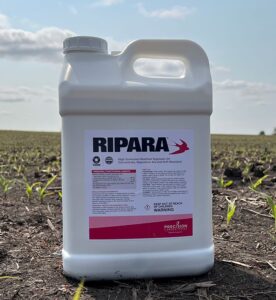
The Endangered Species Act (ESA) restrictions are reshaping herbicide application strategies. Labels now include specific requirements to protect sensitive habitats and species. These often mandate drift reduction technologies to minimize off-target movement. Hoeppner notes, “Products like Ripara™ and Salia™ are built with drift reduction technology, which helps boost overall herbicide performance.” These formulations combine a surfactant with oil, improving coverage and penetration while meeting ESA compliance.
Ignoring these requirements can lead to risks and ineffective weed control. Selecting adjuvants that follow these specifications ensures applicators stay compliant and achieve the intended efficacy.
Why APE/NPE-Free Matters
Environmental and crop safety concerns are accelerating the move away from adjuvants containing alkylphenol ethoxylates (APEs) and nonylphenol ethoxylates (NPEs). Hoeppner explains, “These compounds are known to cause crop injury and can negatively affect the environment.” Choosing APE/NPE-free adjuvants eliminates these hazards and supports sustainable practices without sacrificing performance. It also reduces potential health risks for applicators and communities.
Adjuvants and Spray Quality
Adjuvants do more than enhance herbicide effectiveness; they influence spray droplet size and deposition. “Optimizing droplet size helps eliminate large droplets that bounce off leaves and fine droplets that evaporate or drift off target,” Hoeppner says. Precision Laboratories partners with CPDA through its Application Enhancement Certification program to help applicators match the right nozzle and adjuvant to specific herbicide formulations. This alignment improves on-target deposition and reduces drift, protecting neighboring crops and sensitive areas.
Droplet size matters because herbicide efficacy depends on coverage. Large droplets can reduce control, while fine droplets increase drift risk and environmental exposure. The right adjuvant helps optimize the spray droplet size, ensuring that more active ingredient reaches the target.
Building an Herbicide Strategy
Adjuvant choice should be part of a broader herbicide strategy. Start by reviewing label requirements for ESA compliance. Then consider environmental stewardship; selecting APE/NPE-free products reduces liability and supports sustainability goals. Finally, integrate application technology. Matching adjuvants with nozzle type helps improve coverage and reduces drift, which is critical under ESA guidelines.
Hoeppner emphasizes that this is not guesswork. “Our partnership with CPDA is designed to help growers and applicators understand how adjuvants, nozzles, and herbicides work together to deliver the best efficacy and reduce drift risk.”
Article available in 2026 ESA Technical Guide from CropLife magazine